
A new scroll opens in the Golden Temple. Today we follow the trail of sand… and the civilizations it may be remembering.
Sand is an interesting thing.
It remembers.
It hides.
It buries.
It erases.
Or at least that is the story we often tell about it.
◦
But sand also preserves. It covers and protects. It seals things away from wind, rain, and time
Entire cities have been found sleeping beneath dunes for thousands of years.
Which means that when we walk across a desert today, we may not simply be walking across empty land.
We might be walking across the long memory of the world itself.
Sand as memory.
Not metaphorically. Almost literally.
Wind moves grains. Grains move time. Time moves stories.
And sometimes… a buried city simply waits for the wind to change.
🌬️🏜️ SAND AS MEMORY
Every so often the desert offers small reminders that its surface may not tell the whole story.
In the Sahara, for example, there is a vast circular formation known as the Richat Structure, sometimes called the Eye of the Sahara.
From the ground it looks like layered rock and desert ridges. From space it appears as enormous concentric rings stretching nearly forty kilometers across the landscape.
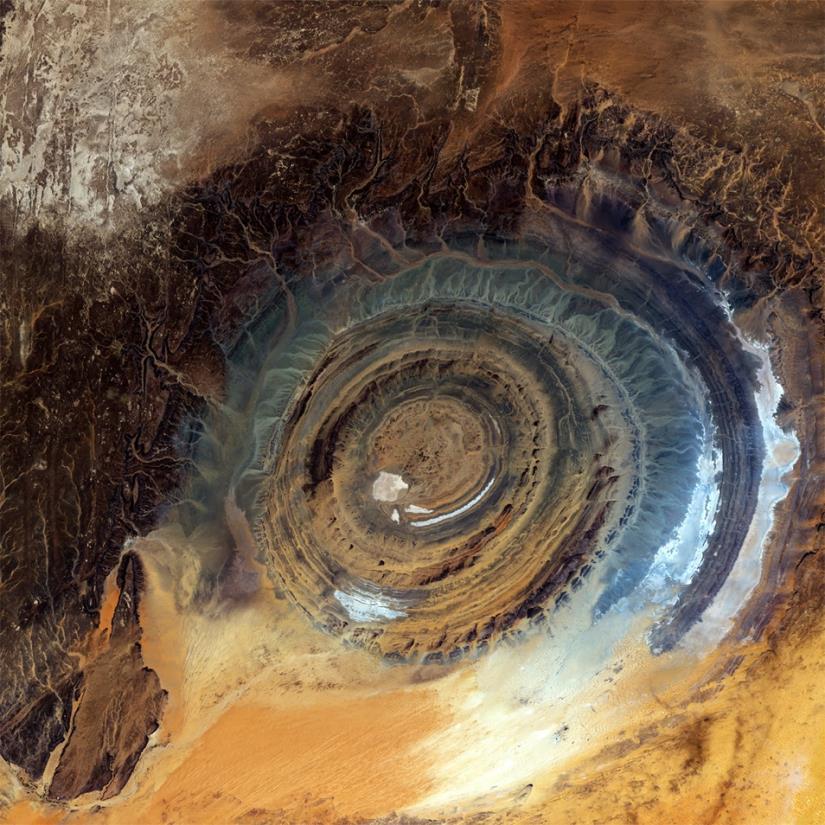
Geologists currently describe it as the result of ancient uplift and erosion.
Yet standing above it, looking at the immense geometry carved into the desert floor, one cannot help but feel a quiet curiosity.
Landscapes like this remind us that deserts often hold features whose full stories may take time
to understand.
◦
HE SAHARA WAS ONCE GREEN
Something interesting begins to appear when we look at the deserts themselves.
Since we are already here, take the Sahara.
Today it is the largest hot desert on the planet. An ocean of dunes stretching across North Africa.
But not very long ago, geologically speaking, it looked completely different.
Lakes.
Rivers.
Grasslands.
Hippos, crocodiles, and herds of grazing animals.
For thousands of years, what we now call the Sahara was a lush landscape often referred to as the Green Sahara.
Which raises a rather delightful question.
If the Sahara was once green…
Then where did all the sand come from?
The desert may not be empty. It may simply be waiting for the right questions.
◦
What if sand is not only burying ancient civilizations… What if some of it is ancient civilizations?
What if deserts are not ancient features of the planet… but relatively recent ones? Full of things we have not dusted off yet.🏺✨
CIVILIZATIONS BENEATH THE SAND⌛
Something else begins to emerge when we step back and look at the broader sweep of human history.
Civilizations do not simply disappear.
Something usually happens to them.
Sometimes the ending comes quietly through gradual change. But sometimes the ending comes through something far more dramatic.
Ice.
Water.
Fire.
Wind.
Movement of Mother Gaia herself.
Throughout the deep past, entire regions of the planet have experienced enormous natural upheavals. Glacial advances. Flooding coastlines. Volcanic winters. Shifting landscapes and poles.
And when events like these occur, they do something interesting to the remains of a civilization.
They create different kinds of tombs.
Ice can preserve a moment in time with astonishing clarity.
Water can bury cities beneath layers of sediment.
Fire and ash can seal entire settlements beneath volcanic stone.
And wind…
Wind can move mountains of sand.
Which adds an intriguing twist to a phrase many of us have heard before.
Ashes to ashes.
Dust to dust.
Perhaps sometimes…
Civilizations to sand.
Which makes deserts feel a little different when we look at them this way.
They may not be empty spaces at all.
They might simply be the Planet’s attic.
Or perhaps its basement.
Vast places where entire chapters of the human story were placed in storage.
Waiting.
If deserts can hide civilizations, another interesting question begins to appear.
It is easy to imagine ancient cities as simple stone settlements scattered across harsh landscapes.
But what if some of them were far more vibrant than we usually picture?
What if they were not only places of survival…
but places of beauty?
Places of sound.
Places of light.
Places of harmony
between people and the natural world around them.
Because when we look carefully at the fragments that remain, hints of something remarkable begin to appear.
Intricate stonework.
Precise alignments with the sky.
Structures whose construction still puzzles
modern engineers. And sometimes… materials that seem to carry unusual properties.
◦
Something else becomes interesting when we look closely at sand itself.
Many deserts are filled with grains made largely of quartz.
Quartz is a crystal.
In fact, one of the most common crystals on the planet.
The same material used today in watches, electronics, and precision instruments because of its remarkable ability to hold and transmit stable frequencies.
Which makes a curious mind wonder.
If entire landscapes are filled with quartz sand…
then the deserts themselves are vast fields of crystal.
What role might sound have played in ancient cities?
What role might vibration have played?
What kinds of knowledge about resonance and harmony may have existed long before our modern instruments could measure them?
Because even today we know that vibration can shape matter.
Sound can move sand into intricate patterns.
Frequency can organize particles into beautiful geometric forms.
So it is not unreasonable to ask a playful question.
What might a civilization have built if it truly understood harmonic resonance?
◦
Another curious piece of the puzzle appears far from the deserts.
Around the Great Lakes of North America, enormous quantities of native copper were mined thousands of years ago.
Not small amounts.
Vast amounts.
Archaeologists have found evidence of extensive prehistoric copper extraction… yet much of that copper seems to have vanished from the archaeological record.
Which raises another interesting question.
Where did it go?
Who used it?
And what might it have been used for? Because copper, much like quartz, interacts with electrical and energetic properties in fascinating ways. And once curiosity starts opening doors like this, it becomes tempting to revisit many of the landscapes we think we understand.
Places like the Grand Canyon.
Now of course, geology provides explanations for how such formations emerged over vast spans of time.
But it is also fair to say something simple about the stories we inherit.
They are called history.
HIS-story.
Not necessarily the final story. And no one ever called it the truth.
Just the best story we currently have.
And sometimes…
new discoveries invite us to keep asking questions.
(We might save that canyon exploration for another scroll.)
If sand can hide civilizations, another question naturally follows.
What were those places like when they were alive?
It is easy to imagine the ancient world as primitive villages scattered across difficult landscapes.
But what if some of those places were far more extraordinary than we usually picture?
Cities that shimmered in the sunlight.
Cities where sound carried through stone in ways we do not fully understand today.
Cities built with materials, knowledge, and vibrations that hint at a very different relationship with the natural world.
And perhaps… not all civilizations were
the same.
Because when we imagine the deep past, we often picture a single line of development.
One civilization rising after another.
But what if the story was more like a garden than a ladder?
Many civilizations.
Many approaches to living.
Many expressions of intelligence.
Some may have leaned deeply into spiritual understanding.
Cultures where harmony, consciousness, and subtle energies were part of everyday life.
Others may have explored technological pathways, shaping metals, stone, and energy in ways that still puzzle us today.
Some may have lived close to the rhythms of Mother Gaia.
Others may have built cities that seemed almost otherworldly.
Different solutions to the same eternal question. How do we live well on this planet?
Imagine cities where quartz and crystalline stone were abundant.
Where vibration and sound were not curiosities but tools.
Where structures were designed not only to stand…
but to resonate.
To heal.
To activate.
We already know that sound can move sand into beautiful geometric forms.
That vibration can organize matter.
So it becomes interesting to wonder what ancient architects may have known about harmonic resonance long before we gave those ideas modern names.
Which brings us to another interesting thought.
In the previous scroll we explored the playful possibility that humanity may not be quite as foreign to the cosmos as we sometimes imagine… perhaps more like visitors who have simply forgotten their long journey.
Travelers with a touch of amnesia.
If that were even partially true, it opens the door for more grounded curiosity to flow through.
Modern anthropology suggests humans have been on the Planet for roughly 300,000 years. Yet most of what we call recorded civilization spans only a few thousand. A blink. Which raises a curious question:
how many chapters may have unfolded long before our written records began?
And perhaps another small question slips quietly into the room.
Who ever said those ancient civilizations had to be human… or only human?
What else may have unfolded during the hundreds of thousands of years before our written records began?
What may have happened even before that?
The past may not be a straight line behind us. It may be a spiral we have walked many times. 🌀
◦
Gaia does not forget. She simply rearranges the evidence. 🌍✨
Because throughout the planet’s history, environments change.
Ice advances and retreats.
Seas rise and fall.
Volcanoes erupt.
Landscapes transform.
And sometimes entire cultures disappear beneath those changes.
Which means something rather poetic may be happening beneath our feet today.
We may not only be building our cities on top of ancient civilizations.
We may also be building them with the remains of ancient civilizations.
When civilizations disappear, their stories do not vanish with them.
Their materials remain.
Stone reused.
Metals melted down and reshaped.
Dust and sand formed from structures that once stood tall.
And perhaps sometimes…
civilizations to cities.
Cities to sand.
Sand to glass.
And what are many of our skyscrapers built out of again?
And perhaps this is where our perspective begins to shift.
Because when we look at deserts through this lens, something rather remarkable begins to appear.
They may not be empty landscapes at all.
Perhaps they are simply the archives of the planet, waiting patiently beneath drifting dunes.
Dunes that move slowly with the wind.
Layers that rise, fall, and shift over centuries.
Entire landscapes acting like enormous pages, gently covering and uncovering fragments of the past.
Cities that once stood tall now resting beneath quiet waves of quartz.
Rivers that once flowed freely now hidden beneath layers of drifting grains.
Stories that slipped from memory not because they vanished…
but because they were placed carefully into storage.
Which makes the desert feel a little different when we walk across it.
Not barren.
Not silent. Just… patient.
Because if sand can hide civilizations, preserve them, and slowly reshape them…
then every desert might be holding more than we currently realize.
Not just ruins.
But chapters.
Pages of a very old library that humanity has only just begun to reopen.
And perhaps that library is beginning to stir again.
◦
Satellite imagery now reveals ancient river systems beneath dunes.
Archaeologists occasionally uncover cities that were once believed to be myths.
Fragments appear here and there, like words emerging from beneath dust on an ancient manuscript.
Little reminders that the past may not be as distant as we once believed.
BUT WHAT IF….THERE’S MORE?
Which leads to an interesting thought.
What if the deserts are not simply hiding history…
What if they are remembering it?
What if the sands of the planet are like the pages of a long-forgotten library, resting just beneath the surface of our collective awareness…
quietly waiting to be read again?
Not so that we can dwell in the past.
But so that the lessons written there might help shape the future.
Because civilizations rise.
Civilizations fall.
And each one leaves behind knowledge, warnings, and wisdom written into the landscapes of the planet itself.
So perhaps the dunes are not empty after all.
Perhaps they are simply Gaia’s way of keeping old stories safe…
until the next generation becomes curious enough to ask the right questions.
And lately…
humanity seems to be asking more questions again. 🏜️📖✨
Something else becomes fascinating when we look a little closer at deserts themselves.
They are not still.
They move.
Slowly, quietly, almost imperceptibly at times… but constantly.
Wind lifts grains of sand and carries them across the landscape.
Dunes rise.
Dunes collapse.
Entire hills of sand migrate across the Planet like slow-motion waves.
In some places a dune may travel several meters each year.
Over centuries… entire landscapes change shape.
Which means something remarkable happens beneath the surface.
The desert does not simply bury things.
It covers and uncovers them.
The wind does not erase the past. It rearranges it. 🌬️🏺
Again and again.
History begins to peek out in unexpected ways.
A stone wall emerges where none stood before.
Fragments of pottery appear where only sand existed the year prior.
Ancient roads, riverbeds, and settlements occasionally reappear as dunes shift and reveal what they once concealed.
Then, just as quietly…
the wind returns.
And the sands move again.
Closing the page.
Waiting for another generation to come asking questions.
Seen this way, deserts feel less like tombs…
and more like breathing landscapes.
Places where the past is periodically revealed and hidden again.
Almost like the Planet is slowly turning the pages of its own archive.
And every so often…
a chapter resurfaces.
Which may explain why some of the most fascinating discoveries in archaeology happen in deserts.
Cities long thought to be myths suddenly appear beneath drifting dunes.
Ancient caravan routes reemerge from beneath sand. Ancient river systems that once carried water through places that now seem impossibly dry.
Little glimpses.
Fragments.
Clues scattered across vast landscapes.
And perhaps this is why deserts invite curiosity.
They feel unfinished.
Like a story paused midsentence.
Because if the sands are constantly moving…
then what else might be waiting beneath them?
How many settlements?
How many roads?
How many forgotten chapters of human experience are quietly resting below the dunes?
Satellite imagery has begun revealing some fascinating clues.
Beneath the dunes lie the faint traces of ancient rivers.
Enormous paleochannels stretching across the desert floor.
Some of them hundreds of miles long.
These were once flowing waterways that carried life across regions that now appear impossibly dry.
And along some of these ancient waterways, archaeologists have found something else.
Human settlements.
Stone circles.
Early megalithic structures such as those discovered at Nabta Playa, which appear to show remarkable awareness of astronomical alignments.
Little reminders that people once lived and thrived in places we now assume were always
barren.
Which brings us back to our wandering question.
If the Sahara was green only a few thousand years ago…
Then deserts may not be permanent landscapes at all.
They may simply be chapters in a much larger environmental story.
Landscapes that change dramatically as the Planet moves through cycles.
Which means the sands of today may not only be geological formations.
They may be the final blankets laid gently over entire worlds that once existed there. Worlds of rivers.
Worlds of animals.
Worlds of beings.
Worlds of cities.
All resting quietly beneath the sand.
And once we begin to see deserts this way…
another thought quietly begins to form.
If landscapes can change this dramatically within a few thousand years…
what other transformations might the Gaia have experienced over the hundreds of thousands of years humans have been here?
The desert may not be ancient. It may simply be what remains after the water leaves. 🏜️💧
◦
And when we look more closely at the timeline of the Gaia’s climate, another curious chapter appears.
Near the end of the last Ice Age, roughly 12,800 years ago, something unusual happened.
Temperatures that had been gradually warming suddenly dropped again.
Glaciers paused their retreat.
In some regions the climate shifted dramatically in what appears to have been a relatively short period of time.
Scientists refer to this mysterious interval as the Younger Dryas.
A name that sounds rather dry…
for a period that seems to involve quite a bit of water.
Melting ice sheets.
Rising seas.
Shifting rivers.
Changing landscapes.
Exactly what caused this sudden climatic turn is still debated.
Some researchers suggest massive pulses of freshwater entering the oceans.
Others explore the possibility of cosmic events or other natural triggers.
What most agree on, however, is that the Planet was going through a period of rapid environmental change.
And when environments change quickly, civilizations living within those environments must change with them.
Sometimes they adapt.
Sometimes they move.
And sometimes…
they vanish from the visible record.
Which brings us back to the dunes.
Because if vast regions of the Planet experienced dramatic environmental shifts as an Ice Age ended…
then it becomes easier to imagine how once-lush landscapes could slowly transform into the deserts we see today.
Grasslands becoming dry plains.
Lakes shrinking into basins.
Rivers fading beneath drifting sand.
And along with those changing landscapes…
the stories of the people who once lived there gradually slipping beneath the surface as well.
Seen from this perspective, deserts begin to feel less like ancient, unchanging features of the planet…
and more like the quiet aftermath of long-forgotten transitions.
Places where Gaia reorganized herself.
And where the remnants of earlier worlds may still be resting beneath the dunes.
Tara changes slowly… until suddenly she doesn’t. 🌍⏳
◦
If Tara (Gaia/Terra 3D) has indeed passed through periods of sudden environmental change, another thought naturally follows.
What might that have looked like for the civilizations living through those moments?
Because when nature moves, it does not always
move gently.
Sometimes the changes come slowly.
Rivers gradually shifting their courses.
Grasslands slowly drying.
Coastlines inching inland over generations.
But other times…
the Planet moves with startling force.
Ice advances.
Oceans surge.
Volcanoes awaken.
The ground itself trembles and reshapes the land.
And when events like these occur, they leave behind very different traces.
Different kinds of endings.
Different kinds of tombs.
Ice can preserve entire moments in time with remarkable clarity. Creatures, plants, even the tools of people sometimes remain frozen for thousands of years.
Water buries cities beneath layers of sediment, slowly sealing them beneath the sea.
Fire and ash can lock entire settlements beneath volcanic stone, preserving streets and homes as they stood on the day the sky turned dark.
Movement of the Planet can tilt landscapes, fracture stone, and send entire regions sliding into new forms.
And when we look across the planet today, we can begin to see hints of these different kinds of resting places.
Cities beneath ice.
Cities beneath oceans.
Cities beneath forests and soil.
And perhaps…
cities beneath deserts.
Each one shaped by the forces that ended them.
Each one waiting patiently for the moment when someone asks the right question and begins looking in the right place.
◦
Which makes the deserts feel even more intriguing. Because if dunes are constantly moving like slow oceans…
then the stories beneath them may not be permanently hidden.
They may simply be waiting their turn to surface again.
A wall here.
A road there.
A fragment of pottery.
A line of stone that hints at something larger resting below.
Little reminders that the past has not disappeared. It has only changed address.
◦
And perhaps this brings us back to the idea we began exploring earlier.
If sand can bury civilizations…and if sand itself may sometimes be made from the remains of those civilizations… then deserts might not just be tombs. They might be archives.
Places where Gaia has stored entire chapters of physical experience. Quietly. Patiently. Waiting for curiosity to return.
◦
What might life in those civilizations have actually felt like?
Not just their endings…
but their living moments.
Cities of sound.
Cities of light.
Different kinds of advanced societies.
Different ways of understanding the world.
Because once we realize how much of the past may still be hidden beneath the surface…
another question naturally appears.
What kinds of worlds might have existed before the sands arrived?
🏛️✨Every ruin was once a living place.
The desert, it seems, may not be empty. It may simply be mid-sentence. 🏜️📜
If wind can move dunes like slow oceans… If ancient rivers once crossed landscapes that are now deserts… And if entire civilizations can vanish beneath sand…
Then how much of our story might still be resting quietly beneath the dunes?
Because when we look across Tara today, we can see many kinds of resting places.
Cities beneath ice. Cities beneath oceans. Cities beneath forests and soil.
And perhaps…
cities beneath deserts.
◦
Which raises one final question worth sitting with.
What if different cataclysms created different kinds of tombs?
We speculate.
We imagine.
We search.
But when it comes to the deepest chapters of the
past… the honest answer, at least for now, may simply be:
We don’t know.