
Humanity has spent a long time wondering a very familiar question.
Across cultures and centuries, stories have appeared about visitors from the stars. Ancient myths speak of sky beings. Modern science searches distant planets for signs of life. Popular culture imagines civilizations traveling through the cosmos.
The questions appear again and again:
Are we alone?
Are there others out there?
◦
These are fascinating questions
But there may be an even more interesting one hiding quietly inside them.
What exactly do we mean when we say alien?
What is an alien, really?
The word itself carries a very simple meaning: something that is not from here.
Not native.
Not belonging.
Not part of this place.
◦
At first glance that seems straightforward enough. Yet the more we look at it, the stranger the word begins to feel.
Everything in the human body was forged in ancient stars.
The atoms that make up our bones, our blood, and the air in our lungs were born long before this planet existed, in our linear terms.
In the most literal sense, every human being is composed of cosmic material that traveled unimaginable distances before becoming a part of us.
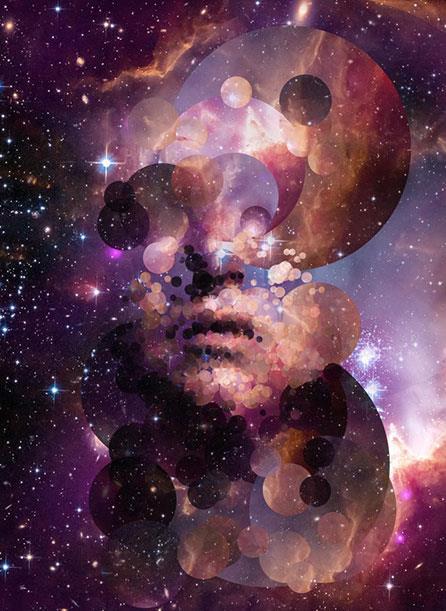
Stardust arguing about visitors from space is already a curious situation.
◦
But the puzzle grows even more amusing when another idea enters the conversation.
Some researchers and thinkers have speculated that human biology may have been influenced or altered at different points in HIS-story by intelligences not originally from this world. Whether one entertains that idea or not is less important than the logical riddle it creates.
Because if such a thing were true even partially— then the human body itself would carry extraterrestrial influence.
Which leads to a wonderfully awkward possibility.
If the current human body were influenced by extraterrestrial intelligence… wouldn’t that make us extraterrestrial as well?
And if that were the case, who exactly would qualify as the alien?
At this point the word begins to wobble.
◦
WHEN WORDS START TO WOBBLE
The moment we step back and look at the bigger picture, the concept of alien starts dissolving into something else entirely. Life in the universe would not be strangers visiting strangers. It would simply be different expressions of the same cosmic family encountering one another in different forms.
Perhaps what we have been calling “aliens” are simply travelers wearing different outfits
The universe is infinite in both directions.
Life appears remarkably persistent.
And consciousness has a curious way of expressing itself in countless forms.
If that is the case, the real mystery may not be whether life exists elsewhere.
The real mystery might be why we ever assumed we were separate from it in the first place.
THE LINES WE DRAW
Humanity has a curious habit of drawing lines where none really exist.
We draw them across maps and call them borders. We draw them between cultures and call them identities.
We draw them between species and call them hierarchy.
And occasionally, we draw them across the stars and call them aliens.
It is a remarkable talent.
Give human beings a perfectly continuous universe and we will still manage to find a way to divide it into categories.
To be fair, this tendency once served a purpose. Early societies needed ways to organize themselves, to protect their communities, and to make sense of a world that felt vast and unpredictable.
The illusion of separation helped humanity take its first steps.
But like training wheels on a bicycle, it was never meant to stay forever.
◦
Over time something interesting happens.
The more we learn about the universe, the more those neat little boundaries begin to dissolve. Physics tells us that everything is made from the same fundamental ingredients.
Biology reveals that life on this planet shares a common ancestry.
Astronomy shows that the atoms in our bodies were forged in ancient stars.
The deeper we look, the less separate things appear.
Which makes the word alien begin to feel slightly… alien.
The illusion of separation is clever and seemingly working overtime. It has shaped much of human HIS-story.
It has influenced how we see other cultures, other species, and even the living world we walk upon.
But every now and then, a simple question slips through the cracks
ENDLESS POSSIBILITIES
What if nothing in the Universe is truly foreign?
What if we viewed the Universe as an infinite pond where everything touches everything else?
A single pebble thrown into the pond creates ripples that touch every part of the pond.
◦
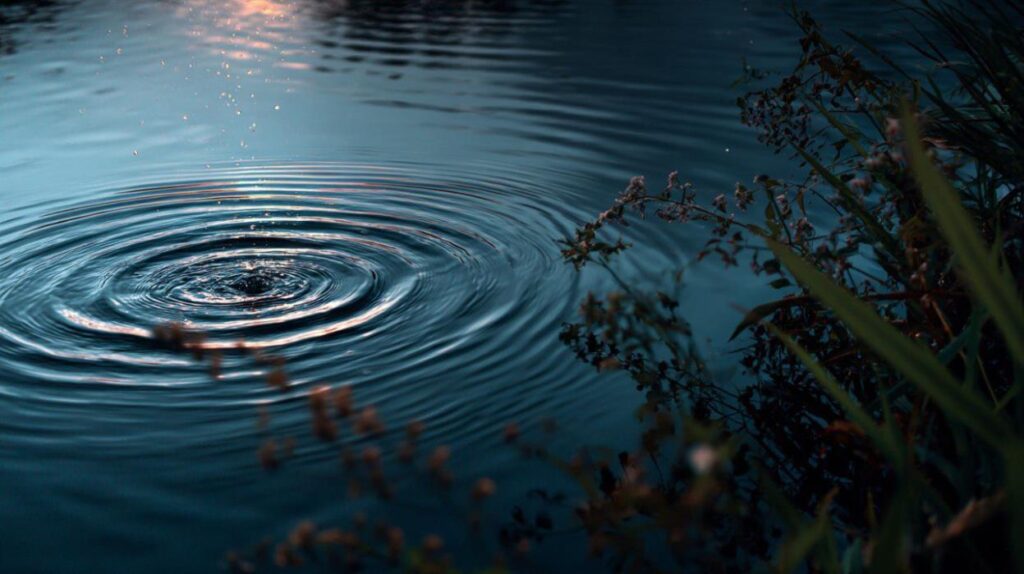
What if we could see that we are the pebbles?
What if we could see that we are the pond as well?
What if the cosmos is not a collection of isolated objects scattered across empty space, but a vast living family of consciousness exploring itself through many forms?
It is an intriguing possibility. And if it were true, the beings we once imagined as aliens might turn out to be something far more familiar.
Distant relatives.
Or perhaps fellow travelers. After all, every story about visitors from the stars assumes something very important:
that there is a place called “here” and another place called “somewhere else.”
But when we look at the universe from a larger perspective, the boundaries between those places start to blur.
Which raises a playful but surprisingly serious question.
If everything in existence emerges from the same cosmic Source…
how could anything truly be alien?
Especially when we apply the concept that everything in our outer world is a mirror of our inner world?
Another curious question appears when we look at the timeline of human civilization.
Many stories about visitors from the stars place these encounters far back in humanity’s past.
Long before current satellites and telescopes.
Which creates a rather amusing puzzle.
How exactly do you call someone a foreigner who arrived before the neighborhood was built?
Imagine moving into a house and declaring that the people who were already living there are the outsiders.
His-story has shown that movie more than once.
It would be a bit like arriving at a campsite, pitching your tent, and then announcing that the mountains are intruding on your view.
The word alien begins wobbling again.
There is also a peculiar paradox in the way knowledge works.
The more convinced we become that we understand the universe, the easier it is to stop asking questions about it.
Certainty can be a comfortable place to sit.
Curiosity, on the other hand, requires us to stand up and wander into the unknown.
But perhaps the more interesting thing this reveals is not about hypothetical visitors from the stars.
It reveals something about us.
Humanity has long drawn lines between “us” and “them.” Borders between nations. Divisions between cultures. Labels like native, immigrant, foreigner.
Yet when we step back far enough to see the larger picture, the whole situation becomes quietly humorous.
Every human being lives on the same small blue world traveling together through space.
The same atmosphere.
The same oceans.
The same star warming us every day.
From the cosmic perspective, we are all living in the same neighborhood.
Which makes the idea of calling someone foreign start to feel a little strange.
After all, if this entire planet is a shared home traveling through a vast universe…
who exactly would count as the outsider?
The illusion of separation was never meant to be a guillotine.
It was a learning tool.
Of course, the human tendency to create separation also served a purpose.
It helped early societies organize themselves, protect their communities, and understand their place in the world at that time from that level of consciousness.
Every stage of consciousness has its role.
But as humanity grows and begins to see the larger picture, the old boundaries start to soften.
The realization slowly emerges that life may not be a collection of strangers scattered across the universe.
It may be something far more familiar.
A vast family of travelers exploring existence together.
👽 THE HIDDEN ASSUMPTION
Human imagination often assumes that visitors from elsewhere would arrive looking something like:
- biological
- physical
- visible
- occupying the same sensory range we do
But that assumption itself is fascinating.
Because humans perceive only a tiny fraction of reality.
A few examples you can lightly point to:
- we see only an extremely small slice of the electromagnetic spectrum
- we hear only a narrow band of vibration
- entire worlds of bacteria and microorganisms existed around us long before we knew they were there
If our senses reveal only a sliver of reality…
how confident should we be that everything else must look the same way we do?
Sometimes the problem is not the mystery we are trying to solve.
Sometimes the problem is the definition we started with.
◦
THE DENSITY / DIMENSION CURIOSITY
Humanity often imagines visitors from the stars arriving in physical spacecraft, stepping out onto the surface of our world as solid beings much like ourselves.
But this assumption carries an interesting limitation.
It assumes that all intelligent life must exist within the same narrow sensory range that humans currently perceive.
Yet even within our own science we know that reality contains layers we cannot directly see.
Radio waves pass through the room around us right now.
Entire ecosystems of microscopic life exist on surfaces we touch everyday.
Dark matter and dark energy appear to make up most of the universe, though we cannot directly observe them.
If so much of reality exists beyond the limits of human perception, it raises an intriguing possibility. What if not all forms of life operate within the same visible bandwidth that we do?
Perhaps some travelers prefer a slightly different frequency of the cosmic neighborhood.
Perhaps the universe is not a collection of isolated worlds scattered across empty space.
Perhaps it is a neighborhood.
A neighborhood that expands endlessly outward… and at the same time unfolds endlessly inward.
◦
The ancient philosopher Socrates once summarized this strange relationship with knowledge very simply:
“All I know is that I know nothing.”
At first glance that statement sounds like humility.
But it might actually be the most intelligent thing anyone has ever said about learning.
Because the moment we believe we already understand everything, curiosity quietly packs its bags and leaves the room.
And without curiosity, discovery has very little reason to stay.
Humanity has accomplished extraordinary things. We have mapped the genome, claimed to have landed machines on distant planets, and begun exploring the structure of the universe itself.
And yet, in many ways, we are still a very young species standing on a small world trying to understand a very large cosmos.
Sometimes we behave like someone who has explored one room of a vast library and concluded they have catalogued every book:
“Welp… looks like I have seen it all.”
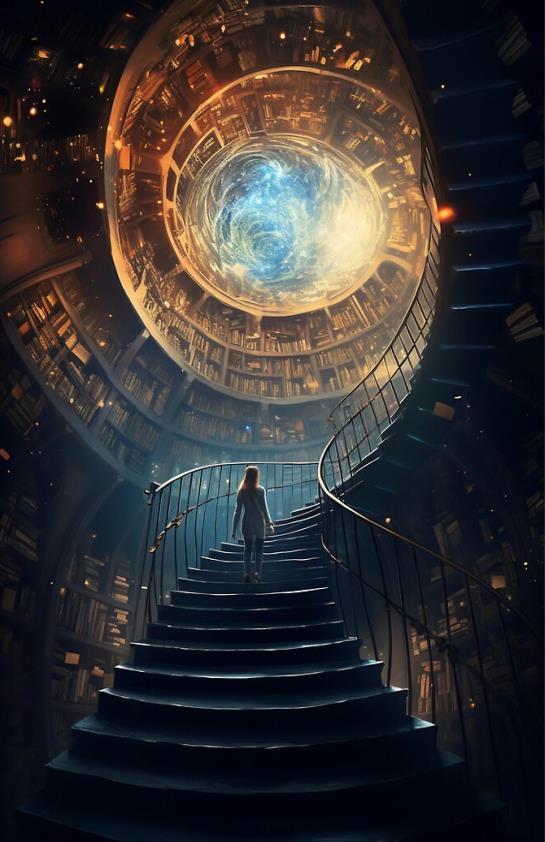
Meanwhile the rest of the library stretches endlessly in every direction.
Fortunately, the library appears to be infinite.
And perhaps the point was never to read every book…
but to remember that we are part of the library itself.
Not separate from it.
Not visitors within it.
But expressions of it. 👽✨
