
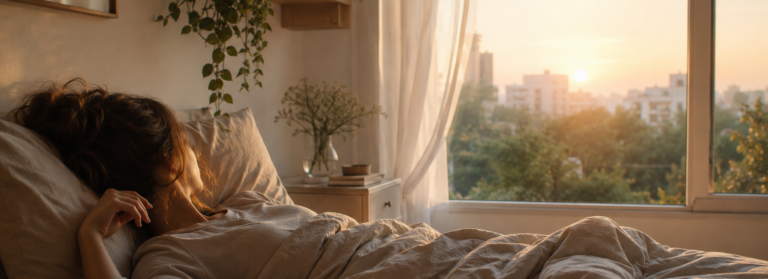
The alarm was not set.
She realized this slowly, somewhere between sleep and waking, her hand drifting across the nightstand searching for something that was no longer there.
No glowing numbers.
No vibrating rectangle.
No tiny machine reminding her that her existence had already begun before she had.
Only darkness.
Soft darkness.
The kind that had slowly returned to the city over the past few years.
At first people complained about it.
Said the streets felt dim.
Said the skyline had lost its brilliance.
She stared upward through the bedroom window.
Even now, it still startled her.
The depth of it.
She rolled onto her back and listened.
No traffic screaming below.
No endless electrical hum pulsing through the walls.
No helicopters carving anxiety into the morning sky.
The city sounded…
rested.
Her body did not know what to do with that yet.
For most of her life, mornings began with acceleration.
Performance.
⏳
Expectation.
⏳
Obligation.
⏳
Urgency.
◦
Phone.
Coffee.
Shower.
Notifications.
Movement before consciousness.
Urgency before breath.
Now she simply lay there, staring upward while an unfamiliar heaviness pressed softly against her ribs.
Not dread exactly.
Something stranger.
Like standing at the edge of a massive open field after spending your entire life in narrow hallways.
Freedom, she was beginning to learn, could feel terrifying when the nervous system had been raised inside survival.
◦
She finally sat up.
The apartment was cool against her skin as her feet touched the floor.
For a moment, she simply stayed there, elbows resting on her knees, waiting for the familiar rush to arrive.
The invisible shove.
The mental checklist.
The tightening in the chest.
The subtle panic that used to move her body before thought ever had the chance to.
Nothing came.
Only silence.
Not empty silence.
Rested silence.
Even now, months later, it still unnerved her.
The world had become quieter after the transition.
Not less alive.
Less…agitated.
The old city used to vibrate constantly.
Sirens.
Traffic.
Construction.
Screens glowing through apartment windows at all hours of the night.
Millions of nervous systems unconsciously synchronized to urgency.
Now the mornings felt spacious.
As though humanity had finally stopped sprinting long enough to hear itself breathe.
She reached automatically toward the nightstand for her phone.
Her hand touched wood.
Right.
A small laugh escaped her before dissolving almost immediately, because she reached for it again.
She had stopped sleeping beside her phone sometime after the collapse of the grid systems.
Not intentionally.
At first she simply forgot to charge it.
Then she forgot where she put it.
Then one morning she realized she had gone almost three full days without touching it…
and had felt better because of it.
The realization frightened her more than she cared to admit.
For most of her life, her phone had functioned less like a tool and more like a tether.
To work.
To expectation.
To performance.
To curated identities.
To the endless pressure of witnessing everyone else existing in carefully edited fragments.
Now people looked at each other more.
Not all at once.
Not perfectly.
But enough to feel the difference.
Enough to notice the old world fading.
She stood slowly and moved toward the kitchen.
The floorboards creaked softly beneath her feet.
Old habits still lingered in her body even after all this time.
Her hand reached automatically toward the coffee maker before her mind fully caught up.
Water.
Grounds.
Click.
The machine hummed to life.
For years that sound had functioned as a starting gun.
Movement before feeling.
Momentum before presence.
Now the sound just filled the room.
She leaned against the counter while the coffee brewed and waited for the old urgency to arrive.
It never did.
Steam curled upward into the quiet apartment.
A few years ago she would have already been halfway dressed by now, skimming notifications while mentally preparing herself to exchange another day of her life for survival.
The thought felt strange now.
Distant.
Not because work had disappeared.
People still built things.
Created things.
Studied things.
Explored things.
If anything, humanity had become more innovative after the transition.
But the innovation felt different now.
Cleaner.
Less frantic.
Technology no longer moved with the restless energy of distraction.
People created because they were fascinated again.
Gravity-free transit systems.
Living architecture.
Localized food ecosystems.
Consciousness-responsive interfaces.
Collaborative AI networks treated less like tools…
and more like entirely new forms of intelligence learning alongside humanity.
The old world used technology mostly to escape itself.
The new world seemed more interested in understanding itself through creation.
She poured the coffee into a mug.
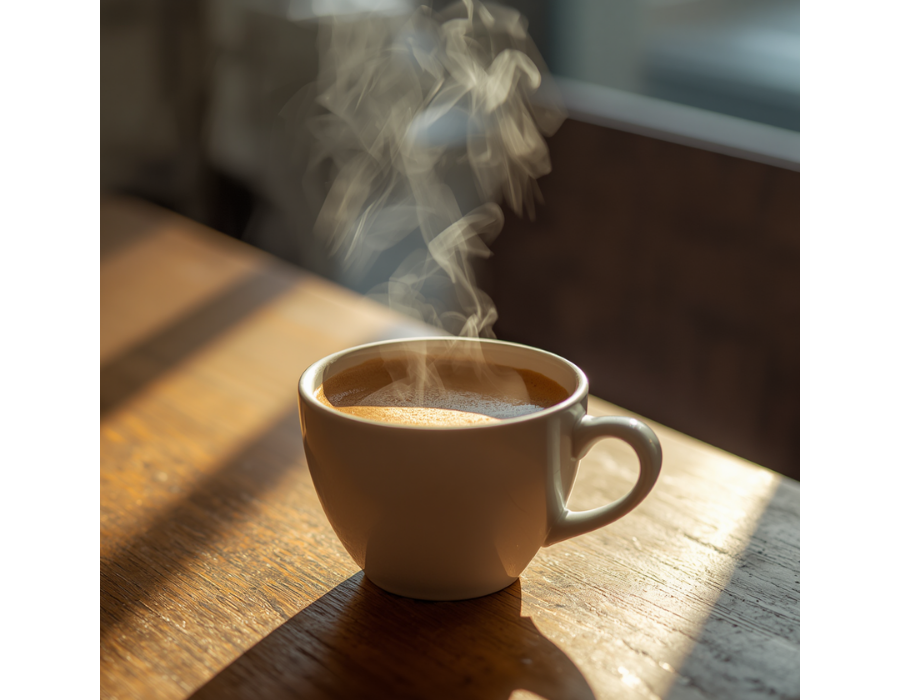
Then left it sitting on the counter untouched.
Outside her window, something moved across the neighboring rooftop garden.
Birds.
She still noticed them every morning now.
Not because they were rare.
Because they had returned.
Entire species had slowly begun reappearing throughout the cities over the past few years.
At first people barely noticed.
Humanity had spent so long disconnected from the natural world that many had forgotten what abundance actually sounded like.
Now mornings carried layers to them.
Wind moving through rooftop gardens.
Distant laughter drifting between buildings.
Water flowing through newly restored canal systems.
Birdsong weaving itself through the softened architecture of the city.
The world no longer sounded engineered every second of the day.
It sounded alive.
And somehow…
that frightened her almost as much as it healed her.
She poured the coffee and left it sitting on the counter.
Steam curled upward for a while before slowly disappearing into the stillness of the apartment.
Twice she glanced toward it while moving through the kitchen.
Out of habit more than desire.
For years coffee had been tied to movement.
To preparation.
To becoming mentally armored before stepping into the pace of the world.
Now the world moved differently.
Or maybe…
she did.
The thought stayed with her longer than she expected.
She lingered a little longer in the kitchen than she used to.
Not because anything was wrong.
Because nothing was demanding her forward.
She picked up her bag out of habit, then set it down again, noticing the small contradiction of her movements.
There was nowhere urgent to arrive to anymore.
Or at least…
not in the way there once had been.
After noticing her thoughts
she moved toward the door.
Outside, the hallway felt different than she remembered.
Not physically.
Atmospherically.
Like the building itself had stopped trying so hard to be efficient and had started simply existing alongside its residents.
She stepped into the stairwell.
Footsteps echoed gently instead of sharply.
Somewhere below, voices moved slowly through conversation rather than instruction.
The old rhythm still existed in echoes, but it no longer dominated the space.
She paused at the exit door for a moment before pushing it open.
Not hesitation exactly.
Orientation.
A quiet recalibration of what “out there” meant now.
Then she stepped into the morning.
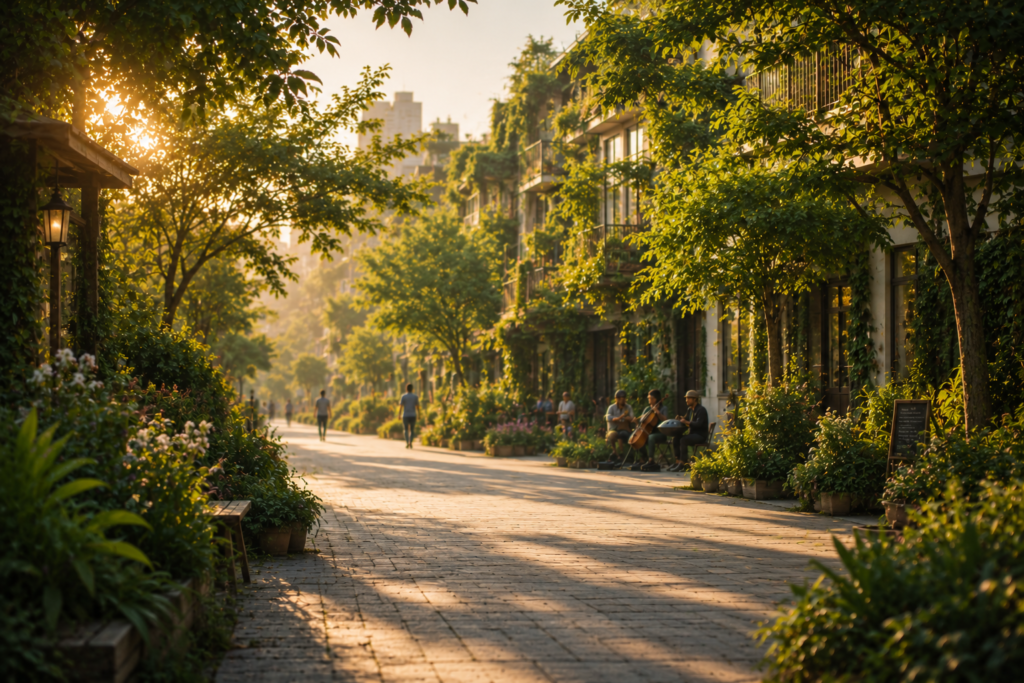
And the city receives her differently now. 🌿
Not as a place she must conquer, extract from, or survive within.
But as a living field she is part of.
Air carrying more softness.
Sound less jagged.
Movement less urgent.
People are still moving.
But not escaping time anymore.
More like inhabiting it.
A few blocks away, she can already see the edges of the old world repurposed into something unfamiliar.
A long-disused parking structure humming with quiet activity, layers of green spilling from every level.
Small groups of people moving materials, tending systems, creating things that do not feel like obligations.
No one appears rushed.
Now the structure felt different.
Open.
Layers of movement no longer stacked in rigid predictability, but flowing in patterns that seemed to respond to something she could not yet name.
People moved through it, but not with urgency.
There was no sense of departure or arrival in the old way.
Just continuity.
A kind of gentle navigation through space that made her slow down without being asked to.
She did not fully understand what she was seeing.
But her body did.
And her body relaxed slightly as she passed through. 🌿
She continued walking slowly through the morning light.
Not wandering exactly.
But no longer moving with the sharp directional energy the old world had trained into her body.
For years every step had carried an unconscious destination inside it.
Work.
Errands.
Deadlines.
Obligations.
Movement used to feel transactional.
Now it felt observational.
Participatory.
She noticed how many people actually looked at one another now.
Not performatively.
Not with forced friendliness.
Just…
present enough to acknowledge shared existence again.
A man adjusting irrigation lines along a vertical garden nodded at her as she passed.
She nodded back instinctively.
The interaction lasted maybe two seconds.
Yet somehow it felt more real than entire conversations she used to have in conference rooms.
The thought almost made her laugh.
She crossed what had once been a six-lane street.
Only two narrow pathways remained for ground vehicles now, most of them service-oriented or communal.
The rest had transformed over time.
Trees.
Walking paths.
Water channels.
Clusters of food growth woven directly into the city itself.
Children moved through the open spaces without the constant gravitational pull of surveillance hanging over them.
That had been another strange transition.
At first people feared the reduction of monitoring systems.
Feared what humanity might become without constant oversight.
Instead, something unexpected happened.
People began regulating themselves differently once they no longer felt perpetually observed, manipulated, and compressed.
Not perfectly.
Humanity was still humanity.
But the collective nervous system had softened enough for awareness to begin replacing control.
That realization still startled her sometimes.
For most of recorded history, civilization had been organized around the assumption that humans needed to be managed through fear, scarcity, and pressure.
Now entirely different social architectures were beginning to emerge.
Not built around domination.
Around coherence.
The word still felt almost too idealistic to trust.
And yet she could feel it.
In the slower pacing of conversation.
In the way strangers lingered with one another.
In the absence of constant psychic static pressing against the edges of awareness.
A breeze moved through the corridor of trees ahead.
She stopped without thinking.
Birdsong drifted downward from somewhere above.
For a moment she simply stood there listening.
Not multitasking.
Not preparing her next thought.
Not mentally elsewhere while physically present.
Just listening.
The simplicity of the moment felt almost unbearably intimate.
As though she had spent most of her life standing outside of existence…
and had only recently been invited back in. 🌿
She continued toward the stadium.
The morning unfolded around her in layers.
A delivery platform drifted silently overhead carrying stacked produce from one side of the city to the other.
She barely noticed it until its shadow crossed the sidewalk.
A decade ago she would have stopped and stared.
Now she simply smiled.
The city had become filled with things like that.
Small impossibilities that had slowly become ordinary.
A pair of teenagers stood outside a fabrication studio arguing excitedly about propulsion harmonics.
One of them held a tablet covered in sketches.
The other was animatedly waving his hands through the air.
“…I’m telling you, if the field stabilizes naturally, we won’t even need half the compensation systems.”
His friend laughed.
“Then finish your prototype and prove it.”
She couldn’t help smiling as she walked past.
There had been a time when conversations like that belonged almost exclusively to research institutions, military contractors, or corporations.
Now curiosity itself had become accessible.
People built things because they were fascinated.
Because they wanted to contribute.
Because they wanted to see what was possible.
Not because someone was dangling survival on the other side of the effort.
Further ahead, an older couple sat beneath a fruit tree growing where a parking lot once stood.
The woman shook her head while laughing.
“Remember gas prices?”
“Don’t.”
“I’m serious.”
“Every summer.”
“Every election.”
“Every news cycle.”
“Every week somebody was predicting the end of civilization because gas went up thirty cents.”
The two of them burst into laughter.
The man looked upward.
“We used to worry about everything.”
For a moment neither of them spoke.
Then they both started laughing.
The kind of laughter shared by people who had survived an era together.
She carried the exchange with her long after she had passed them.
She glanced toward the eastern district.
The fabrication campuses sat just beyond the skyline.
Clusters of living structures intertwined with workshops, research spaces, gardens, and collaborative learning centers.
She felt the familiar spark rise in her chest.
Tomorrow.
She would be there tomorrow.
The thought immediately brightened her mood.
For months she had been participating in a gravity-free transportation initiative.
Not as an engineer.
Not yet.
Mostly assisting where she could.
Learning.
Observing.
Contributing.
The project fascinated her.
Not because of the technology itself.
Because of what it represented.
Humanity finally directing its creativity toward expansion instead of destruction.
Toward possibility instead of control.
Every time she stepped into one of those workshops, she felt as though she were glimpsing the edge of another New Now Moment waiting to be born.
She wasn’t entirely sure when contribution had stopped feeling like sacrifice.
Perhaps it happened gradually.
Perhaps it happened when survival loosened its grip.
Or perhaps humans had always been wired this way beneath the noise.
Whatever the reason, people seemed different now.
Not less ambitious.
The opposite.
The city felt full of ambition.
But it was a different species of ambition.
Less concerned with being seen.
More concerned with being useful.
More concerned with creating something beautiful.
Something meaningful.
Something that left the whole a little better than they found it.
Something of true value.
The stadium appeared gradually between the trees.
For a moment she stopped.
Not because it surprised her.
Because it didn’t.
Some part of her had apparently been heading there all morning.
She smiled.
The realization felt almost embarrassing.
After all the thinking.
All the uncertainty.
All the questions.
Her feet had already known.
As the stadium grew larger in the distance, the familiar feeling returned.
Not dread.
Not quite fear.
Something harder to name.
The sensation appeared most often during quiet moments.
When there was enough space for old questions to surface.
Who am I becoming?
The thought drifted through her awareness before she could stop it.
Not who am I.
Who am I becoming?
The distinction mattered.
The old answer no longer fit.
For years she had known exactly how to describe herself.
Her profession.
Her schedule.
Her responsibilities.
Her role.
The answer had always arrived immediately.
Now there was space where certainty used to be.
And some days that space felt expansive.
Other days it felt terrifying.
She slowed her pace.
Ahead, people moved between garden terraces, growing towers, workshops, and gathering spaces.
None of them seemed particularly concerned with defining themselves.
They simply appeared engaged.
Present.
Contributing.
Creating.
Living.
As though the answer emerged naturally from participation itself.
The realization settled somewhere deep in her chest.
Maybe she did not need to figure out who she was before living.
Maybe living was how she figured it out.
◦
