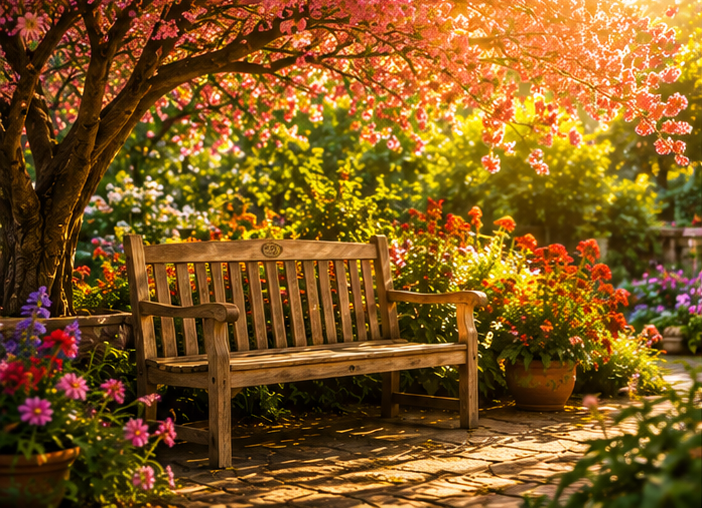
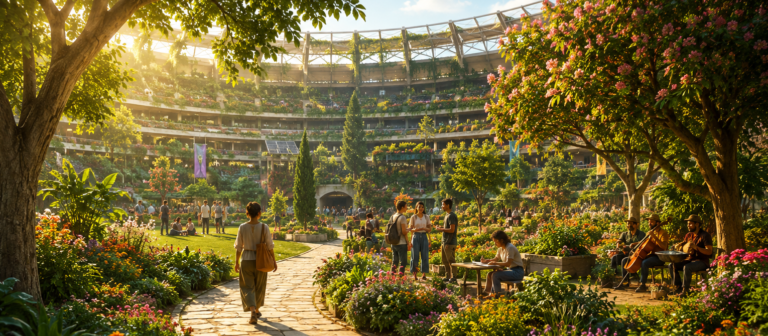
The stadium rose above the surrounding gardens like a relic from another age.
The structure itself remained largely unchanged.
The purpose it served had not.
Years ago tens of thousands of people gathered there to watch a handful participate.
Now tens of thousands participated.
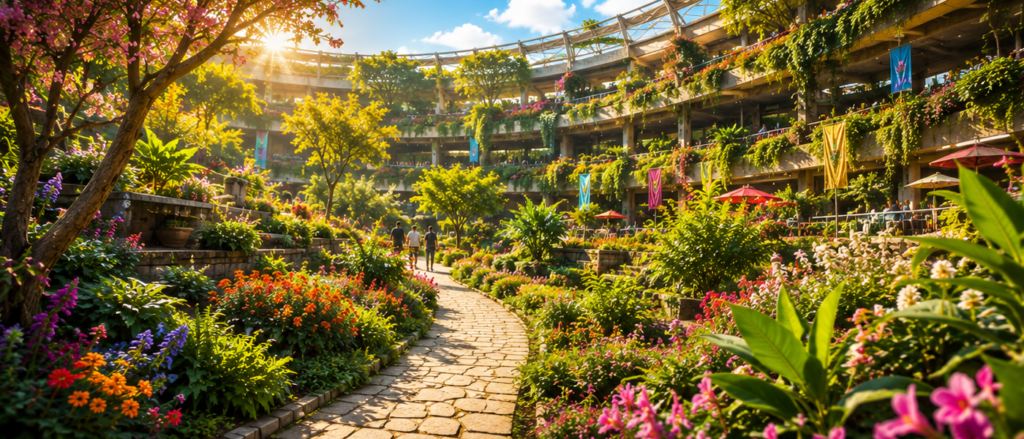
The upper levels overflowed with food gardens.
Fruit trees.
Medicinal plants.
Vegetables.
Pollinator corridors.
Mushroom basements.
The old parking lots surrounding the complex had become one of the largest community growing systems in the region.
From above, the entire area resembled a living organism more than a piece of infrastructure.
And somehow it felt more like a stadium now than it ever had before.
As she approached one of the entrances, a familiar voice called out.
“There she is.”
She looked up and laughed.
Marcus leaned casually against a support beam, soil already streaked across his shirt.
“You’re late.”
“I’m not late.”
“You absolutely are.”
“There isn’t even a schedule.”
Marcus pointed dramatically toward the sky.
“You’ve disrupted the entire ecosystem.”
She laughed despite herself.
The exchange felt easy.
Natural.
The kind of friendship she once struggled to make when everyone’s lives were organized around exhaustion.
Marcus had originally been an infrastructure analyst before the transition.
Now he spent half his time helping coordinate food systems and the other half assisting with ecological restoration projects throughout the city.
At least this month.
People changed directions more freely now.
Not because they lacked commitment.
Because they had space to explore curiosity without gambling their survival.
Before she could answer, another voice called from behind.
Before she could answer, another familiar voice emerged from one of the lower terraces.
“You’re coming tomorrow, right?”
She turned and smiled.
Amara climbed the steps carrying a small case tucked beneath one arm.
The case immediately gave her away.
Prototype components.
Of course.
Some things never changed.
Marcus led her through one of the old entrances.
The concrete beneath her feet had been preserved intentionally.
Not out of nostalgia.
Out of remembrance.
The city had stopped pretending it could build a future by erasing its past.
Evolution, people had learned, worked differently than that.
The structure still carried echoes of what it once was.
But now those echoes supported something entirely new.
Sunlight poured through openings where massive advertising displays once hung.
Food terraces climbed upward through multiple levels.
Fruit trees occupied spaces that had once sold merchandise.
Water moved quietly through channels integrated into the architecture itself.
Everywhere she looked, something was growing.
Plants.
Food.
Friendships.
Ideas.
Possibilities.
As they walked deeper into the stadium, she noticed something else.
People were smiling.
Not the forced smile of customer service.
Not the smile people wore when trying to convince themselves they were happy.
A different kind.
The kind that appeared when someone’s attention was fully engaged in what they were doing.
A woman knelt beside a bed of herbs while explaining soil composition to a small group of children.
Several levels above, a team worked on expanding one of the vertical growing systems.
Near the center of the structure, a group gathered around a holographic projection discussing water distribution patterns.
Nobody appeared rushed.
Nobody appeared checked out.
Everyone seemed…
there.
Present.
The realization struck her unexpectedly.
The old world had spent enormous amounts of energy trying to motivate people.
Incentivize them.
Pressure them.
Threaten them.
Reward them.
Manipulate them.
As though contribution required coercion.
As though humans naturally wanted to do nothing.
Yet here they were.
Creating.
Learning.
Building.
Sharing.
Not because someone was dangling survival on the other side of the effort.
Because participation itself felt meaningful.
Because contribution itself nourished something inside them.
⚡
Marcus must have noticed the look on her face.
“You did it again.”
She glanced toward him.
“Did what?”
“You started observing instead of participating.”
She laughed.
“I was participating.”
“You were studying everybody else participating.”
“That’s still participating.”
“It absolutely isn’t.”
She rolled her eyes.
Marcus grinned.
“You’ve been standing there for almost five minutes.”
She looked around.
To her horror, he was right.
They continued toward the center gardens.
The old field remained intact, though almost unrecognizable now.
What had once been perfectly maintained grass had transformed into a vast mosaic of food systems, pollinator habitats, gathering spaces, learning circles, and ecological experiments.
Children ran through pathways between growing beds.
Several elders sat beneath fruit trees exchanging stories.
A group nearby debated the merits of different atmospheric harvesting systems.
The conversation sounded suspiciously similar to sports fans arguing statistics decades earlier.
She smiled.
Some things really never changed.
Only the subjects.
As Marcus disappeared toward one of the irrigation terraces, she found herself wandering deeper into the gardens.
Nobody questioned it.
Nobody asked where she was supposed to be.
Nobody handed her a schedule.
The freedom still felt strange sometimes.
A small part of her occasionally expected someone to appear with instructions.
A role.
A metric.
A deadline.
Instead, there was only life unfolding around her.
She passed a group of elders teaching children how to graft fruit trees.
Further ahead, several people sat beneath a canopy discussing atmospheric water harvesting systems.
Nearby, two musicians experimented with instruments she had never seen before.
No one appeared rushed.
No one appeared idle.
The distinction fascinated her.
For years she had unconsciously believed there were only two options:
Working.
Or not working.
Productive.
Or unproductive.
Useful.
Or wasting time.
Now those categories seemed increasingly difficult to locate.
Everything appeared woven together.
Learning.
Creating.
Resting.
Sharing.
Exploring.
As though humanity had finally stopped separating life into competing compartments.
She stopped beside one of the central terraces and watched for a while.
An old habit surfaced.
The instinct to ask what everyone did.
What their jobs were.
How they supported themselves.
How they fit.
The questions felt oddly outdated now.
Almost quaint.
The people before her were not easily categorized.
A woman discussing ecological systems was also helping develop educational programs.
One of the gardeners spent part of his week working with gravity-free transit research teams.
A musician nearby contributed to habitat restoration projects.
An elderly man teaching soil regeneration had apparently spent decades designing software systems before the transition.
Lives seemed less fixed now.
Less compressed.
More fluid.
Perhaps this was what had been lost before.
Not freedom.
Fluidity.
The ability to evolve without first dismantling an entire identity.
To follow curiosity.
To become interested in something new.
To begin again.
The thought settled gently inside her.
How many people had carried dreams they never explored?
How many inventions?
How many songs?
How many discoveries?
How many versions of themselves?
Waiting patiently behind a life that never seemed to leave enough room?
She looked around.
The gardens stretched outward in every direction.
Filled with growth.
Filled with possibility.
Filled with people who had finally been given enough space to become more than one thing.
And for the first time that morning…
the uncertainty inside her felt a little less like a void.
And a little more like an invitation. 🌿✨
She found herself settling onto a low stone wall near the center terraces.
The musicians continued playing somewhere nearby.
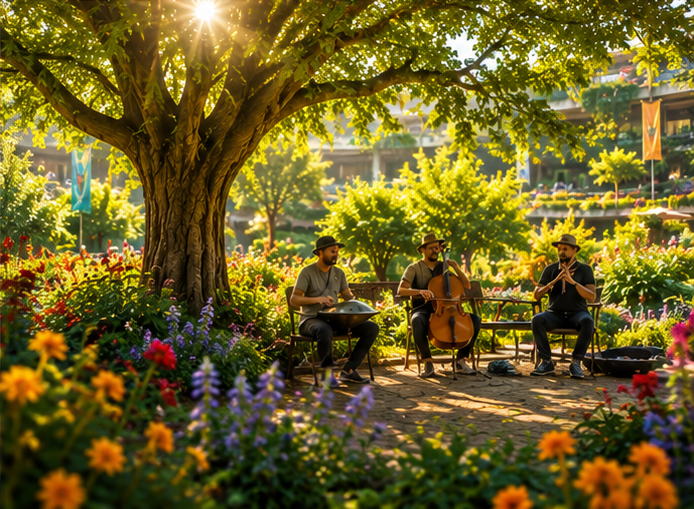
The melody drifted through the gardens almost like wind.
Subtle.
Unobtrusive.
Yet somehow everything around it felt more alive.
The plants moved gently.
People moved gently.
Even the conversations seemed to settle into a different rhythm.
She smiled at the thought.
Maybe humanity had finally remembered that life was not a machine to optimize.
Maybe it was something closer to an instrument.
Something to be tuned.
🌿
◦
A shadow crossed the path in front of her.
She looked up.
An older woman carrying a basket of herbs paused nearby.
“You look like you’re thinking.”
The observation caught her off guard.
She laughed.
“Is it that obvious?”
The woman glanced at her.
“Only to people who’ve done a lot of it.”
The woman sat beside her without asking permission and set the basket down.
For a few moments they simply watched the gardens.
No pressure to fill the silence.
No obligation to perform conversation.
Just presence.
Something humanity seemed to have rediscovered.
Finally the woman spoke.
“First transition?”
She turned.
“What?”
The woman smiled.
“The identity part.”
Immediately she understood.
“Oh.”
A laugh escaped her.
“That obvious too?”
“More obvious.”
The woman nodded toward the gardens.
“You’d be surprised how many people ended up here during the first few years.”
She watched a group of children helping harvest tomatoes.
“Lost?”
The woman considered the question.
“Open.”
The answer landed somewhere unexpected.
“Those aren’t the same thing.”
“No.”
The woman smiled.
“But most people confuse them.”
◦
The woman reached into her basket and adjusted a bundle of herbs.
For a few moments neither of them spoke.
The musicians continued somewhere beyond the terraces.
Their melody drifted softly through the gardens, weaving itself between conversation, birdsong, and the gentle movement of leaves.
“What changed?” she finally asked.
The woman smiled.
“Everything.”
Then she laughed.
“And almost nothing.”
The answer settled somewhere familiar.
Like a truth she already knew but had never heard spoken aloud.
The woman gestured toward the gardens.
“We still grow food.”
Toward a nearby learning circle.
“We still teach.”
Toward a lower terrace where several people were gathered around translucent design projections.
“We still build things.”
A group of children ran past carrying baskets of vegetables, laughing as though they had nowhere else they needed to be.
“And we still make mistakes.”
The woman smiled.
“Plenty of those.”
She found herself laughing.
The future, it seemed, had not perfected humanity.
It had simply given humanity more room to be
…human.
🌿
The thought lingered.
For most of her life, progress had been described as a destination.
A point somewhere ahead.
A finish line.
A solution.
Yet everything around her felt less like a solution and more like a living ecosystem.
Always changing.
Always adapting.
Always becoming.
“The biggest surprise,” the woman said, “was realizing that free energy wasn’t really the thing people were looking for.”
She looked over.
“What do you mean?”
The woman considered the question.
“It removed a barrier.”
“That’s all?”
The woman laughed.
“As though removing one of humanity’s largest barriers is a small thing.”
She laughed too.
“Fair point.”
The woman nodded toward the gardens stretching through the old stadium.
“For generations, people thought they were searching for abundance.”
Her gaze drifted toward the terraces.
“They already had abundance, what they were really searching for was space.”
Space to rest.
Space to create.
Space to learn.
Space to change.
Space to fail.
Space to begin again.
Space to discover who they were beyond survival.
For a while neither of them spoke.
Nearby, one of the musicians shifted into a different melody.
Several birds landed among the fruit trees growing along the upper terraces.
A breeze carried the scent of herbs, soil, and sunlight through the air.
The woman closed her eyes for a moment.
Just listening.
Just being.
No urgency.
No objective.
No invisible finish line moving further away every time she approached it.
When she opened her eyes again, she realized something.
The uncertainty she had been carrying all morning was still there.
But it felt different now.
Less like a void.
More like a horizon.
The woman tilted her head.
“What?”
She blinked.
“What what?”
“That look.”
“What look?”
The woman laughed.
“The one people get when they stop trying to solve their lives and start participating in them.”
She felt herself laughing before she could stop it.
“That’s a very specific look.”
“You’d be surprised.”
The older woman stood, gathering her basket.
“Besides…”
She glanced toward one of the lower terraces.
“You already have something you’re excited about.”
Her eyes followed the woman’s gaze.
The workshop levels.
The gravity free transit projects.
The fabrication spaces woven into the lower portions of the old stadium.
A small smile appeared before she could stop it.
The woman noticed immediately.
“There it is.”
“Tomorrow?” the woman asked.
She nodded.
“Tomorrow.”
The smile widened despite her best efforts.
The woman laughed.
“I know that feeling.”
“What feeling?”
“Being excited about tomorrow.”
The woman adjusted the basket beneath her arm.
“For a long time people confused excitement with stress.”
That earned a laugh.
“That’s accurate.”
“They’d gotten so used to pressure that anticipation felt unfamiliar.”
The woman smiled.
“Then eventually people remembered there was a difference.”
The woman began moving toward one of the upper terraces.
After a few steps she paused and looked back.
“Oh.”
“What?”
The woman smiled.
“Don’t let tomorrow become more important than today.”
Then she disappeared into the gardens.
◦